A change of perspective –
from above you see what really matters.
Successful public transport digitalisation does not start with software. It starts with a clear view of processes, people and reality.
Six focus areas.
One approach.
From tendering to operations and integration. Everything from one source – centred on the method that sets us apart.
Public transport projects rarely fail
because of technology.
Tender cancelled
All bids are too expensive. The budget is insufficient. Six months are lost, and the process starts again – usually with significantly higher total costs.
Supplier says: "Yes, fulfilled"
During the implementation specification or shortly before go-live: "That is not our process." The result is an expensive redesign or dissatisfied users who do not accept the system.
Change requests escalate
What was missing in the requirements specification becomes expensive later. The budget doubles. Some suppliers factor exactly that in from the start.
In the requirements specification. In process definition. In prioritisation. That is exactly where we start.
Three areas.
One method.
We consider tendering, operations and integration together. Because they belong together.
Tender management
For all standard and process-intensive IT systems in public transport
A tender is only as good as its requirements specification. And a requirements specification is only as good as the process behind it. We bring process maps and profiles from almost 30 years of practice, adapt them to your organisation and create a specification that suppliers can calculate realistically. The wheel does not have to be reinvented every time – best practice saves time, reduces costs and creates quality from the outset. We apply innovation precisely where it is really needed.
- Process map as the starting point – not as an add-on
- Structuring into mandatory, desired, optional and conceptual requirements
- Realistic cost assessment before publication
- Proven standards, individually adapted to your organisation
- Selection of the appropriate tender procedure for your project
Knowledge and experience are our capital. Shared properly, they save time and costs for everyone involved: for you as the client, for the supplier in calculation, and for us in consulting. This creates a result that all three sides can actually implement.
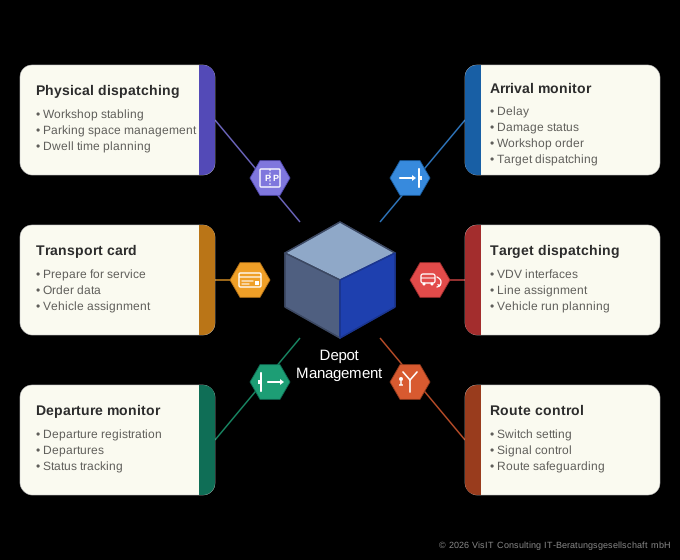
Public transport operations management
Processes, organisation, people
A new system is of little value if the organisation does not develop with it. We design operations management as an interplay of processes, structures and employees. With clear responsibilities, documented procedures and change management that involves people rather than overrunning them.
- Integrated operations management, maintenance management, depot management, ITCS and control centre concepts
- Process optimisation before tendering, tool selection and implementation
- Change management with employees, not against them
- Process-oriented training to understand how the solutions are used
- Documentation as a working tool, not as a file binder
SAP and system integration
When systems have to work together
Maintenance software, ERP, e-procurement and materials management – each system may work on its own, but together they often become chaotic. We design interfaces that simplify data flows, eliminate duplicate entries and reflect inventory costs realistically. With a clear distinction between what remains in SAP and what is handled by the specialist application.
- Connect maintenance software to SAP Materials Management
- E-procurement and ERP integration with a clear data model
- Interface design for long-term maintainability
- Separation of consumables and serialised components
Sequence
is everything.
Most consultancies jump straight into the requirements specification. That is why so many projects run into problems later.
We take a different approach. In a sequence that has proven itself over more than 20 years – from the first process discussion through to acceptance.
Process. Priorities. Budget. Requirements specification. Tendering. Implementation specification. Training. Testing and acceptance.
Clarify processes
With process maps and profiles that we bring from practice. Interfaces and use cases are defined where they are useful for the requirements specification.
Set priorities
What is truly mandatory? Where is standard sufficient? What is wishful thinking? Clear structuring instead of vague wishes – also in the second iteration.
Set a realistic budget
We know the market. What costs what. Which solutions are sustainable in the long term. Before you issue a tender – not only after all bids are too expensive.
Create the requirements specification
Structured, calculable and with a conceptual level. Suppliers can calculate. You can compare. Change requests remain the exception, not the rule.
Support the award process
Evaluation matrix, supplier discussions and clarifications. We bring the experience to know what suppliers can really deliver – and where promises are empty.
Review the implementation specification
What the supplier implements must match the requirements specification. We review critically, identify gaps and create clarity before code is written.
Design training
Process-oriented training in which users do not just learn clicks, but understand why a system works the way it does. Acceptance instead of resistance.
Testing and acceptance
Structured acceptance with test automation where possible. Nothing goes live that has not been checked. The handover to operations is the conclusion, not the beginning of the problems.
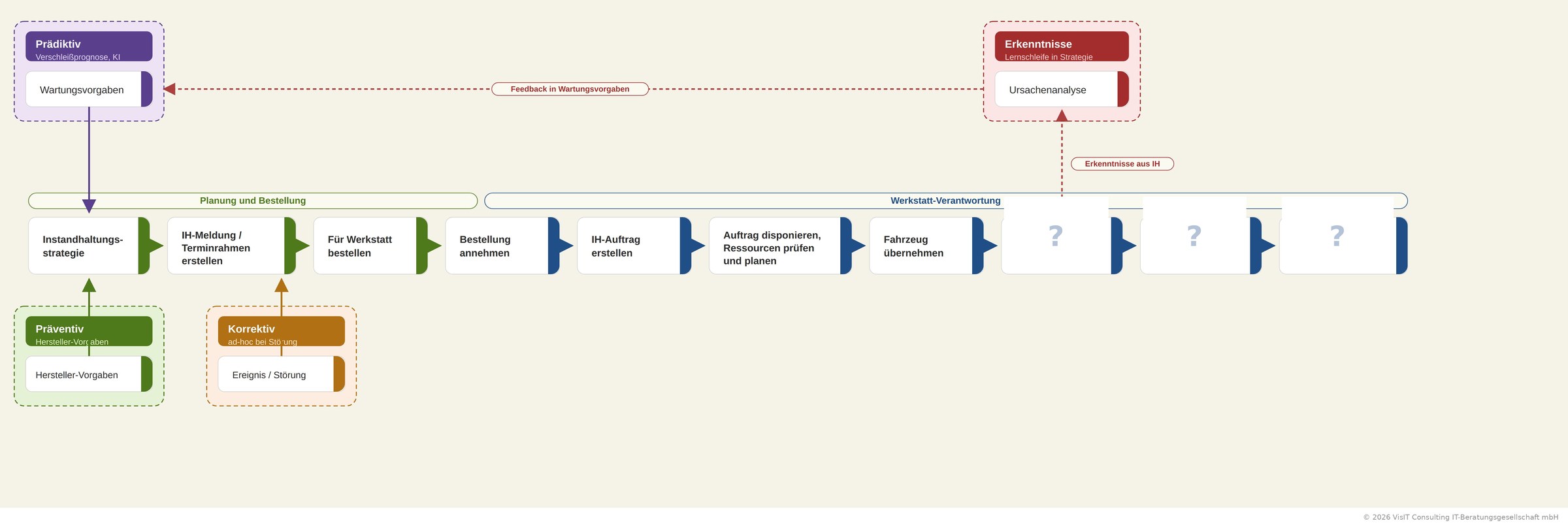
Example of a process map: maintenance process
Up to this point, we show you how we break down the process. The final three steps – the core of our method in operational implementation – are discussed in a personal meeting.
Six principles
that change everything.
Involve people
Employees are not the problem – they are the solution. We design change so that people are willing to go along with it.
Processes before tools
Before you buy a system, the process must be clear. We help you design organisation and process optimally.
Detail requirements
A good requirements specification is not thick – it is precise. Suppliers can calculate, costs can be compared and change requests are minimised.
Actively manage risks
Projects do not fail because of technology, but because of risks. Structured risk management frees up resources and accelerates decisions.
Lean project management
Project management that does not become excessive. Lean, focused and based on clear decisions instead of endless steering committees.
Document smartly
Documentation is not a paper tiger; it is proof of the work delivered. It is the final result before acceptance – manuals that users understand and use.
Practitioners.
Not slide presenters.
Everyone on the team has seen public transport from the inside. As a consultant, engineer or person responsible.
Thomas Klein
Graduate engineer in electrical engineering. Digital transformation, IT strategy, public transport and regional rail. Management and process consultant.
In IT consulting since 1988
Christian Cramer
Graduate engineer in transport and civil engineering. Planning and engineering services for public transport.
Knows both the client and supplier sides
Herbert Kirchbeck
Electrical engineering, data networks and communication. VdS-recognised GIV expert.
Planning, installation and inspection according to VdS311
SAP-Partner
SAP integration, PM and Logistic, Materials Management and ERP solutions with a public transport focus.
SAP specialists in the consulting network

Kay Tewes
Operations management, process optimisation and public transport strategies from practice.
Public transport practitioner
No sales pitch.
A situation assessment.
Tell us about your situation. We listen, ask questions and tell you honestly whether and how we can help.
Heinhauser Höh 17
42781 Haan
Email: t.klein@visit-consulting.com